
Difference Between Seamless and ERW Stainless Steel Pipes – Which One Should You Choose?
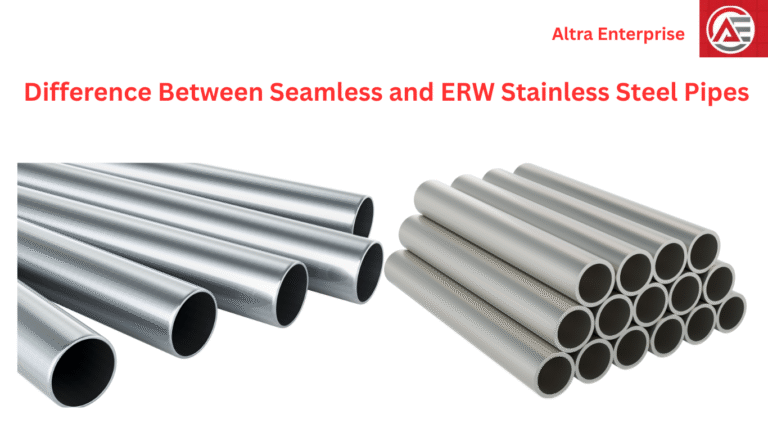
What Is a Seamless Stainless Steel Pipe?
A seamless stainless steel pipe refers to a pipe that is made by extrusion of a solid billet that has been heated to the right temperature. This makes the stainless steel pipe strong, durable, and the best pipe for handling high pressure and temperature due to its absence of seams..
Key Characteristics:
No weld seam
Higher mechanical strength
Better pressure resistance
Smooth internal and external finish
Manufactured in limited sizes
Applications of Seamless Pipes:
Oil and gas pipelines
Heat exchangers
High-pressure boilers
Chemical and fertilizer plants
Power plants
Because of the robustness of the material used and the fact that it doesn’t have leaks due to its seamless stainless steel design, they may be suitable for situations that require a “fail-safe”.
What Are ERW Stainless Steel Pipes?
ERW pipes are stainless steel pipes manufactured by winding steel sheets to form a cylindrical pipe and welding along the length using high-frequency electric resistance.
There is a seam in such a pipe, but because of the level of technology we now have when welding, it is almost impossible to detect the seam. In fact, it doesn’t affect the strength of the pipe.
Key Characteristics:
Welded along the length
Uniform wall thickness
Cost-effective and widely available
Ideal for low and medium-pressure applications
Available in longer lengths and large quantities
Applications of ERW Pipes:
Water pipelines
Structural purposes
Scaffolding
Fencing and furniture
Automotive exhaust systems
The ERW stainless steel pipes are widely used for general engineering construction purposes in order to reduce cost and increase availability, where higher strength is not paramount.
Key Differences
| Featue | Seamless Pipe | ERW Pipe |
|---|---|---|
| Manufacturing | Extruded from a solid billet | Rolled and welded from steel coil |
| Weld Seam | None | Has a longitudinal weld |
| Strength | Higher, no weak point | Slightly lower due to weld seam |
| Pressure Handling | Excellent | Moderate |
| Surface Finish | Smoother (inside & outside) | May show slight weld line |
| Cost | Higher | More economical |
| Availability | Limited sizes and lengths | Widely available in standard sizes |
Plain or Welded Stainless Steel Pipe: What to choose?
Select Seamless Stainless steel pipe if:
Your project involves high pressure or temperature.
You need maximum corrosion resistance.
Applications are in the chemical, oil, gas, or power sectors.
Choose ERW Stainless Steel Pipe if:
Your application is structural, general, or commercial.
You’re working with medium or low-pressure systems.
Cost is important, and you need large quantities.
Uniform wall thickness and standard lengths are acceptable.
The most common grades of SS pipe are:
- SS 304 – Stainless steel pipes that are best known for their corrosion-resistant capabilities. Hence used generally.
- SS 316 – The most common grade, as the molybdenum added into this grade improves corrosion resistance against chloride corrosion. It performs better than 304 against saline, chemicals, and marine environments.
- SS 202 – It’s also an economical grade of stainless steel pipes that are mostly used in structural and decorative works.
Why buy from Altra Enterprise?
- Supplying many grades and sizes of stainless steel pipes.
- Very competitive pricing and bulk supply.
- Quick dispatch and on-time delivery.
- Guidance for you to choose the right SS product for your application.
- Serving customers throughout Gujarat and in all of India.
Conclusion
Seamless and ERW stainless steel pipes are of immense importance to different industries. They differ, mainly in the area of strength, integrity, and thus reliability; hence, seamless pipes are widely preferred over ERW pipes in high-strength demanding applications. Moreover, seamless pipes are indispensable in sectors where reliability and high-pressure applications are most necessary, as it is widely used in power generation, oil and gas, and chemical industries. Whereas ERW pipes are quite inexpensive and commonly used in water supply lines, structural usages, and engineering industry applications, based on budget, operational pressure, and the specific industrial requirement.
