
Introduction to the difference between hr cr and GI sheets
Before procuring steel for construction, roofing, fabrication, or other industrial applications, it is necessary to understand the differences in properties between HR, CR & GI sheets. Generally, in India, a fabricator, builder, contractor, or industrial user procuring different types of steel sheets for his construction activities uses different types depending on the required strength, desired quality of finish and anticipated resistance to corrosion, and cost of steel and the types of steel typically used are hot rolled (HR), cold rolled (CR), galvanized iron (GI) sheets.
Each type of steel sheet has its own advantages and disadvantage so buying the incorrect material may add to the overall cost and decrease the longevity as well as give rise to problems while starting fabrications or constructions. Whether you require roofing or structural construction and fabrication work or industrial cladding in Ahmedabad, Gujarat, or anywhere in India, gaining knowledge of these steel types will guide you in making the correct buying decision.
Below are details to help you completely understand the differences between HR, CR & GI sheets, along with their manufacturing processes, usages, and further details on advantages and disadvantages.
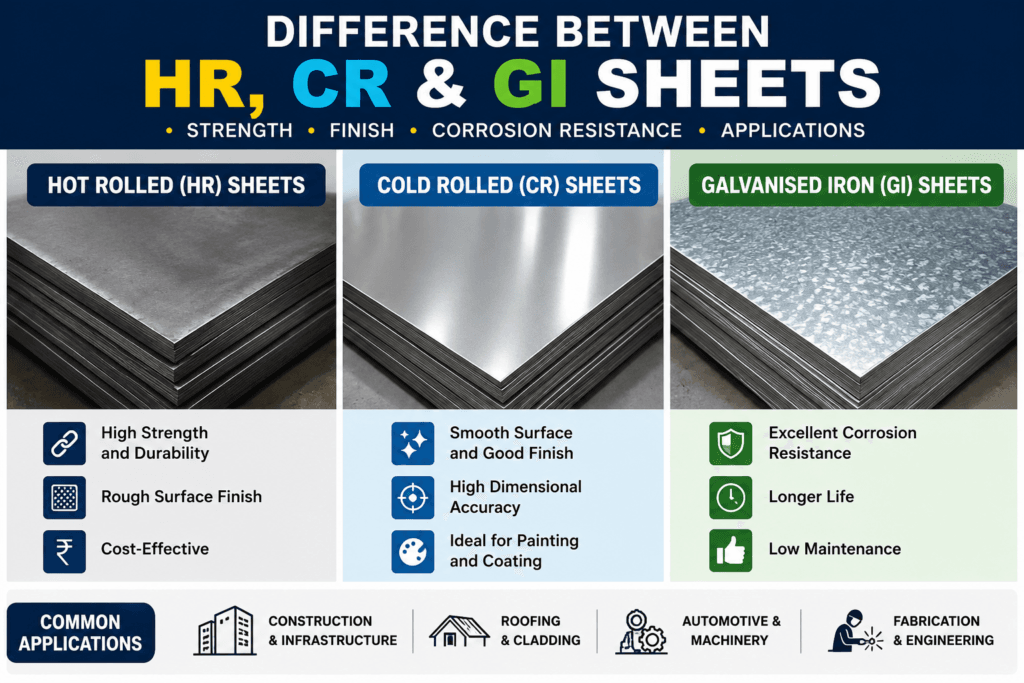
What Are HR Sheets?
HR Sheet Meaning
HR Sheets are also known as Hot Rolled Steel Sheets. Manufacturers produce steel sheets through the Hot Rolled Steel process. They can be produced at high temperatures, which generally exceed the steel’s recrystallisation point.
The hot-rolled steel process also facilitates easy shaping of the steel into large sheets or coils.
Features of HR Sheets
- Rough surface finish.
- High strength.
- Economical to use and easy to access.
- It is good for heavy fabrication.
The surface finish of hot-rolled sheets is mostly a bluish grey, and the edges tend to be slightly rounded.
Common Applications of HR Sheets
Manufacturers used HR sheets in the following applications:
• Structural fabrication
• Industrial machinery
• Construction framework
• Railway parts
• Storage tanks
• Automotive frame structure
The hot-rolled sheets are the best choice when the appearance does not play the most important role, but it needs more strength.
Advantages of HR Sheets
- Cost-effective price, HR Sheets are less costly than CR & GI Sheets.
- High strength, useful for heavy industrial & constructional purposes.
- Easy fabrication & cutting, and welding.
- Can be available in a large size; it can be used for industrial purposes.
Disadvantages of HR Sheets
- Not a smooth surface finish.
- Lower geometrical accuracy.
- Easy to rust unless protected.
What Are CR Sheets?
CR Sheet Meaning
CR sheets stand for Cold Rolled Steel Sheets. Manufacturers produce CR sheets by processing HR (hot-rolled) sheets. After cooling, they passed sheets through the rollers at ambient room temperature.
The benefits of this process are enhanced surface finish, tighter dimensional tolerance, and improved mechanical properties.
Features of CR Sheets
- The surface finish is smooth.
- Higher dimensional accuracy is attained.
- Enhanced appearance is gained.
- The hardness is improved.
- Suitable for precision uses.
Cold-rolled sheets appear much cleaner and shinier than hot-rolled sheets.
Common Applications of CR Sheets
Applications for CR sheets include:
- Furniture
- Car panels
- Household goods
- Interior fabrication
- Precision
- components
- Decorative finishes
Advantages of CR Sheets
- Smooth finish
Applications where looks are important.
- Higher accuracy
Consistent gauge and width.
- Higher surface quality
Suitable for painting/coating.
- Higher strength
Cold rolling hardens the material.
Disadvantages of CR Sheets
- More expensive than HR Sheets
- Less resistant to corrosion compared to GI sheets
- Unfit for outdoor use without coating
What Are GI Sheets?
GI Sheet Meaning
GI sheets stand for Galvanised Iron Sheets.
It is done when manufacturers cover steel sheets with zinc to prevent them from oxidising and rusting.
Features of GI Sheets
- Resistant to corrosion
- Zinc-plated surface
- More durable, has a longer life
- Good to use outside
- Silver-shiny look
Common Applications of GI Sheets
Some popular applications of GI sheets are:
- Roof sheets
- Wall cladding
- Air conditioning ducts
- Factory sheds
- Fencing
- Farm houses
Advantages of GI Sheets
- Great Resistance to Corrosion
Best for damp and open air areas.
- Good Durability
Low maintenance required.
- Suitable for Roofing
Widely used for roofing at residential and industrial sites.
- Protection from Weather
Appropriate to use for Indian weather.
Disadvantages of GI Sheets
- More expensive than HR sheets
- The coating of zinc can be rubbed off after some time
- requires more attention in welding
Difference Between HR, CR & GI Sheets
| Feature | HR Sheets | CR Sheets | GI Sheets |
|---|---|---|---|
| Full Form | Hot Rolled | Cold Rolled | Galvanized Iron |
| Surface Finish | Rough | Smooth | Shiny Zinc Coated |
| Corrosion Resistance | Low | Medium | High |
| Cost | Lowest | Medium | Higher |
| Accuracy | Moderate | High | High |
| Best Use | Structural Work | Precision Work | Roofing & Outdoor |
| Appearance | Industrial | Decorative | Metallic Finish |
| Strength | High | Higher Hardness | Durable |
| Outdoor Use | Not Recommended | Limited | Excellent |
Which Sheet Is Best for Roofing?
Uses of roofing material in India:
- GI sheets are a suitable roofing material in the Indian context as it offers good resistance to rusting and other harsh climatic conditions, including moisture and heat.
The HR sheet is best used for the roofing structure and support system of roofing, and the GI sheet is used for the roof surface.
Read our guide on the best mild steel sheets for roofing in India.
Which Sheet Is Best for Fabrication?
HR Sheets
Used for:
Heavy fabrication
Structural applications
CR Sheets
Used for:
Precision fabrication
Decorative applications
Which Sheet Is Best for Construction?
In construction;
- HR sheets provide structural strength.
- CR sheets for internal work and applications where accuracy is important.
- GI sheets for roof cladding and the like.
Manufacturing Difference Between HR, CR & GI Sheets
HR Sheets:
Manufacturers make sheets by hot rolling the steel at high temperatures.
CR Sheets:
These are made by cold rolling HR sheets at room temperature.
GI Sheets:
These are steel sheets coated with Zinc.
How to Choose the Right Sheet
When purchasing steel sheets, think about:
Application use
Is it for roofing, fabrication, or structure?
Environmental conditions
If for outdoor use, they should be GI sheets.
Cost of purchasing steel sheets
HR sheets are cheaper than others.
Surface finish
CR sheets will have a good surface finish.
Resistance to corrosion
GI sheets have the best results outdoors.
HR vs CR vs GI Sheets Price Difference
The typical:
HR Sheets— Least expensive
CR Sheets– Midrange price
GI Sheets– Most expensive (due to zinc)
For current prices, consult the “Mild Steel Sheets price in India” page
Best Sheet for Indian Weather Conditions
In India, they characterise it by:
- Rain
- High humidity
- High temperature
- Dusty conditions
HR sheets and CR sheets find applications in structures where strength and aesthetics are primary concerns.
And also, they are readily fabricated and can achieve a smooth finish.
When protected with a primer/ paint system, these sheets are usually corrosion-resistant.
GI sheets are used where corrosion resistance is of primary importance
Applications in Ahmedabad & Gujarat
Ahmedabad and Gujarat:
HR Sheets
- Industrial fabrication
- Machinery
- Warehouses
CR sheets
- Furniture
- Decorative panelling
GI sheets
- Roofs
- Sheds
- Claddi
Frequently Asked Questions
Q-1. What is the difference between HR, CR & GI sheets?
HR sheets are hot rolled at high temperatures, giving a rough surface finish suitable for structural use. CR sheets are cold rolled at room temperature, giving a smooth and precise finish ideal for decorative and precision work. GI sheets are steel sheets coated with zinc for excellent corrosion resistance suitable for roofing and outdoor applications.
Q-2 Which sheet is better for roofing?
Roofing with GI sheets in India is considered to be better because of the coating of zinc on them that make GI sheet good corrosion resistance towards heat, rain, and humidity. HR sheets are used for roofing structural support, while GI sheets are used for the actual roof surface and cladding.
Q-3. Are GI sheets better than HR sheets?
GI Sheets are ideal for outdoor use and for roofing purposes because their coating protects from rust. GI Sheets vs HR sheets for industrial usage. Structural fabrication: HR Sheets are used for structural fabrication. Its price range is relatively lower compared to GI sheets, and it provides more durability for structures.
Q-4. Which sheet is the cheapest?
HR sheets are the cheapest among the three. CR sheets are moderately priced, and GI sheets are the most expensive due to the additional zinc coating manufacturing process. However, GI sheets offer lower maintenance costs and longer service life, making them economical for outdoor use.
Q-5. Can HR sheets rust?
Yes. HR sheets can rust if not protected with paint, primer, or coating. Without protection, they are vulnerable to moisture and humidity. For outdoor applications, either GI sheets or properly coated HR sheets should be used to prevent corrosion.
Q.6. Where can I buy HR, CR, and GI sheets in Ahmedabad?
Altra Enterprise at Kathwada GIDC, Ahmedabad, supplies HR, CR, and GI mild steel sheets in all sizes and thicknesses. Call +91-7600305469 for an instant quote and bulk pricing with fast delivery across Gujarat and India
Conclusion
A buyer benefits when they are aware of HR vs CR vs GI sheets to choose suitable steel material for construction, roofing, fabrication, and industrial purposes. Each kind of sheet is used for different purposes based on its strength, surface finishing, and rusting property, and cost.
- Select HR sheets for their structural strength.
- Select CR sheets for precision and look.
- Select GI sheets for their durability and use in roofing.
Looking to buy HR, CR, or GI mild steel sheets? Altra Enterprise supplies premium quality mild steel sheets in all sizes and thicknesses, with bulk stock and fast delivery across Ahmedabad and pan-India.
Moreover, before placing your order, check our complete MS sheet weight chart in kg to calculate
The exact weight of your required sheet size and thickness.
Furthermore, if your project also requires stainless steel pipes, use our free SS pipe weight calculator for instant Pipe weight calculation in kg.
Need HR, CR or GI Sheets? Get Instant Quote!
All Types | All Sizes | Bulk Stock | Pan India Delivery
📍 Kathwada GIDC, Ahmedabad, Gujarat | 📧 info@altraenterprise.in

