
Introduction
A stainless steel sheet weight chart is the most important document for any fabricators, contractors, manufacturers, engineers and industrial purchasers. When selecting Stainless steel sheets for an order or to purchase it becomes necessary to know the sheet weight of the material. Transportation costs, fabrication costs, material handling costs, the whole budgeting of the project are dependent on the quantity (weight) of the material.
Stainless Steel Sheets are available in various grades such as SS 202, SS 304, SS 316 and others, with thickness ranging from a thin foil up to heavy plates and size is generally provided as per the customer’s need.
The majority of the Stainless Steel will be priced on weight. If you know any form of calculation for Stainless Steel sheet weight, then an estimate of the price can be made.
This guide explains how to calculate stainless steel sheet weight, the Stainless Steel sheet weight chart, and shows the size of Stainless Steel Sheet.
What Is a Stainless Steel Sheet?
A sheet of stainless steel is essentially a flat product that is made from stainless steel alloys that include various elements (e.g. Chrome) which enhance corrosion resistance and add strength.
Standard stainless steel sheets include:
- SS 202
- SS 304
- SS 316
- SS 310
- Duplex stainless steel
Applications:
- Building applications
- Industrial fabrications
- Food processing industries
- Chemical plant
- Pharmaceutical industry
- Kitchenware
- Architectural purposes
- Automotive part fabrication
Why Is Stainless Steel Sheet Weight Important?
Stainless steel's density.
The weight of stainless steel sheets relies upon the density of stainless steel
Average density:
| Grade | Density |
|---|---|
| SS 202 | 7.85 g/cm³ |
| SS 304 | 7.93 g/cm³ |
| SS 316 | 7.98 g/cm³ |
For practical calculations, most fabricators use:
7.85 to 8.00 kg/dm³
There is little difference between weights per grade.
Calculating stainless steel sheet weight
Where:
L = meter
W = meter
T = millimetre
Density = 7.93 (SS 304)
Example Calculation
Let’s say you have a:
Length = 2.44 m
Width = 1.22 m
Thickness = 2 mm
Calculation:
Weight = 2.44 x 1.22 x 2 x 7.93″
Weight = 47.18 kg
The approx weight of a 2mm thickness SS 304 sheet, 2440 X 1220 mm, is therefore 47 Kgs.
Add this line after the formula section:
“For SS pipe weight, use our free
Standard Stainless Steel Sheet sizes in India
The following are standard stainless steel sheet sizes
| Size (mm) | Size (Feet) |
|---|---|
| 2440 × 1220 | 8 × 4 |
| 3000 × 1500 | 10 × 5 |
| 2000 × 1000 | 6.5 × 3.3 |
| 2500 × 1250 | 8.2 × 4.1 |
| 6000 × 1500 | 20 × 5 |
Among these, the most popular size is:
2440 mm × 1220 mm (8 ft × 4 ft)
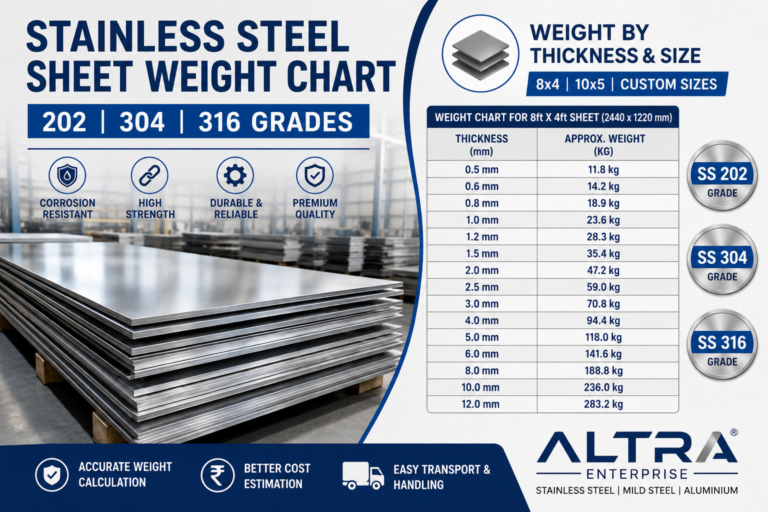
Stainless Steel Sheet Weight Chart (8 × 4 Sheet)
The below stainless steel sheet weight chart is calculated for a standard 8 4 (2440 X 1220mm) sheet.
| Thickness (mm) | Approx Weight (kg) |
|---|---|
| 0.5 | 11.8 |
| 0.6 | 14.2 |
| 0.8 | 18.9 |
| 1.0 | 23.6 |
| 1.2 | 28.3 |
| 1.5 | 35.4 |
| 2.0 | 47.2 |
| 2.5 | 59.0 |
| 3.0 | 70.8 |
| 4.0 | 94.4 |
| 5.0 | 118.0 |
| 6.0 | 141.6 |
| 8.0 | 188.8 |
| 10.0 | 236.0 |
| 12.0 | 283.2 |
Stainless Steel Sheet Weight Chart (10 × 5 Sheet)
Sheet Size:
3000 × 1500 mm
| Thickness (mm) | Approx Weight (kg) |
|---|---|
| 1.0 | 35.7 |
| 1.2 | 42.8 |
| 1.5 | 53.6 |
| 2.0 | 71.4 |
| 3.0 | 107.1 |
| 4.0 | 142.8 |
| 5.0 | 178.5 |
| 6.0 | 214.2 |
| 8.0 | 285.6 |
| 10.0 | 357.0 |
The difference of weight between SS 202, SS 304 and SS 316 sheets
| Grade | Density |
|---|---|
| SS 202 | 7.85 |
| SS 304 | 7.93 |
| SS 316 | 7.98 |
For actual buying, Sheet weights are practically identical. Selection depends more on:
- Corrosion resistance
- Chemical resistance
- Application environment
- Cost
than on weight.
Applications of SS 202 Sheets
SS 202 sheets find various applications where average corrosion resistance is adequate.
Applications are:
- Decorative sheets
- Furniture
- Railing
- Kitchenware
- Interiors
- Architectural work
Advantages are:
- Cost-effective
- Good strength
- Good looks
Applications of SS 304 Sheets
SS 304: The workhorse stainless steel grade.
Applications:
- Food processing machinery
- Water tanks
- Industrial fabricating work
- Chemical process equipment
- Architectural designs
- Dairy machinery
Advantages:
- Outstanding corrosion resistance
- Straightforward fabrication
- Good welding properties
- Durability for many years of service
Applications of SS 316 Sheets
SS 316 has an extra element Molybdenum, which is responsible for its increased corrosion resistance.
Applications:
- Marine parts
- Chemical plant equipment
- Pharmaceutical manufacturing
- Coastal construction sites
- Medical appliances
Advantages:
- Enhanced corrosion resistance
- Increased chemical resistance
- Endurance
Factors Affecting Stainless Steel Sheet Weight
The following variables will influence the weight of a stainless steel sheet:
Thickness
As you would expect, the weight of the sheet obviously depends on thickness. For instance, a 4mm sheet would weigh about four times more than a 1mm sheet.
Sheet Size
Naturally, larger sheets weigh more. An 8’x4′ sheet is heavier than a 10’x5′ sheet. (At the same thickness).
Grade Density
SS 202, 304 and 316 have slightly different densities but as a rule, this has only an insignificant effect on the weight.
Surface Finish
There is no appreciable change in weight according to the finish:
- 2B
- No.4
- Hairline
- Mirror
- Matt
The weight of stainless steel sheet per square meter
Weight per square meter approximately:
| Thickness | Weight (kg/m²) |
|---|---|
| 0.5 mm | 3.97 |
| 0.8 mm | 6.34 |
| 1.0 mm | 7.93 |
| 1.2 mm | 9.52 |
| 1.5 mm | 11.89 |
| 2.0 mm | 15.86 |
| 3.0 mm | 23.79 |
| 4.0 mm | 31.72 |
| 5.0 mm | 39.65 |
| 6.0 mm | 47.58 |
This table helps fabricators quickly estimate weight for custom sheet sizes.
How Buyers Use Stainless Steel Sheet Weight Charts
Why Fabricators and Industrial Buyers refer to Stainless steel sheet weight charts:
For Costing
To find out the overall materials needed.
For quotations
To formulate proper quotations for projects.
For Freight
To calculate transport charges.
For Handling
To estimate the handling equipment and labour.
For Stock control
To get knowledge of the available quantity in the stock room.
Tips Before Purchasing Stainless Steel Sheets
Before you place an order:
Check Grade
Select among SS 202, SS 304 or SS 316 based on the application.
Check Thickness
Confirm the actual thickness of the required sheet.
Check Finish
Select an appropriate finish depending on the requirement:
- 2B
- Mirror
- Hairline
- No.4
- Check Dimensions
Ensure required standard sizes or custom sizes are correct as per the project need.
Calculate Weight
Use stainless steel sheet weight chart for the project cost.
Frequently Asked Questions
Q.1. What is the weight of a 1 mm thick SS sheet?
Q.2. What is the weight of a 2 mm SS sheet?
A sheet of SS 2440×1220 mm thickness, 2mm in weight, is about 47.2 Kg.
Q.3. Is SS 316 heavier than SS 304?
SS 316 has a density greater than SS 304, but it does not matter by weight so much.
Q.4. Which is the best grade of Stainless steel sheet?
The choice of stainless steel depends on use:
SS 202 for budget considerations
SS 304 for general use
SS 316 for use in a sea or chemical environment
Q.5. How do I find the weight of a stainless steel sheet?
Use the formula;
Weight (kg) = Length width thickness density
Use a density of 7.93 for SS 304
Conclusion
Stainless steel sheet weight chart helps in material estimating to buyers, contractors, fabricators and engineers for various projects. If you use SS 202, SS 304 or SS 316 sheets, you need to understand sheet weight for budget, transportation, fabrication, stocking and more.
By using the formulas and charts mentioned in this document, you can calculate stainless steel sheet weight easily and pick the best steel sheet for your job. Make sure that you verify the sheet size, thickness, grade, and finish before purchasing for any industrial job.
Buy SS 202, 304, and 316 stainless steel sheet price per kg at Altra Enterprise, Ahmedabad.”
Need SS or MS Material? Get Instant Quote!
SS 202, 304, 316 | MS Pipes | Aluminium | Pan India Delivery
📍 Kathwada GIDC, Ahmedabad, Gujarat | 📧 info@altraenterprise.in

