
Introduction Stainless Steel Pipe Weight Chart
The stainless steel pipe weight chart is an essential buying tool for fabrication, contractors, engineers, manufacturers, and industrial buyers. Whether you’re buying stainless steel pipe for construction, food grade usage, chemical industries, pharmaceutical applications, or industrial fabrication, weight matters significantly when you need to get estimates for material and transport costs, structural load needs.
Stainless steel pipe can be of many different grades, sizes, and schedules. India uses most SS 304 and SS 316 grades and Schedules such as Schedule 10, 40 and 80.
Since stainless steel pipes are sold predominantly by weight, the buyers may want a standard stainless steel pipe weight chart to be able to ascertain total pipe amount needed for their specific application.
In this guide we discuss: stainless steel pipe weight calculation, pipe size charts and schedules, pipe weight tables and applications.
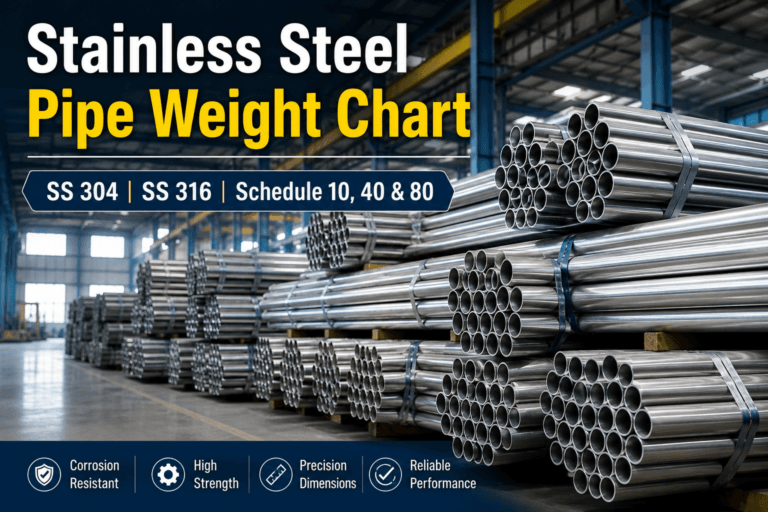
What Is a Stainless Steel Pipe?
- Good resistance against corrosion
- High strength
- Longer durability/service life
- Weldability
- Beautiful appearance
- Less maintenance
Some common applications of stainless steel pipes:
- Industrial pipelines
- Water treatment plants
- Food processing industries
- Pharmaceutical industries
- Oil & gas industries
- Chemical industries
- Construction work
Why Is Pipe Weight Important?
Knowledge of pipe weight allows the buyer to:
Estimate Material Cost-
Buyers purchase the majority of stainless steel pipes based on a per-kilogram rate.
Calculate Freight charges-
The cost of freight is determined by the weight of the pipe.
Design of a structural system-
The weight of the pipe is important for designing the supporting members.
Inventory control-
Precise calculation of pipe weight leads to an efficient ordering and stock-keeping system.
Fabrication planning-
Fabricators do Cutting, welding, lifting and erection activities of the pipe by its weight.
Common Stainless Steel Pipe Grades
SS 202
Good strength and economic price.
Uses:
- Furniture
- Decorative fabrication
- Internal structure
SS 304
It’s the most widely used of all the stainless steel grades.
Uses:
- Food processing
- Water pipelines
- Industrial fabrication
- Dairy plants
- Pharmaceutical industries
Advantages:
- Very resistant to corrosion
- Good weldability
- Easy fabrication
SS 316
Has molybdenum, which gives it higher corrosion resistance.
Uses:
- marine industries
- chemical plants, Pharmaceutical industries
- Coastal construction projects
Advantages:
- Very good
- chemical resistance
- Good life service
- Better corrosion protection
Stainless Steel Pipe Weight Formula
The standard calculation method of stainless steel pipe weight is:
Weight (kg/m) = (OD – WT) × WT × 0.0246615
Where:
- OD=Outside Diameter(mm)
- Thickness=Wall Thickness(mm)
This formula calculates the estimated weight of pipe per meter.
Example Calculation
Weight = (60.3 − 3) × 3 × 0.0246615
Weight = 57.3 × 3 × 0.02491
Weight = 4.24 kg/m
Therefore, the weight of a stainless steel pipe with a 60.3 mm outside diameter and 3 mm wall thickness is approximately 4.28 kg per meter.
“Use our free SS pipe weight calculator
for instant results without manual
calculation”
Understanding Pipe Schedule
The wall thickness of the pipe is known as the schedule.
The following are the popular schedules.
| Schedule | Application |
|---|---|
| SCH 10 | Low-pressure piping, light usage |
| SCH 20 | Medium-duty piping |
| SCH 40 | General industrial use |
| SCH 80 | High-pressure applications |
As the schedule increases, the pipe weight also increases.
Stainless Steel Pipe Weight Chart (per m)
½ Inch Pipe
| Thickness | Weight (kg/m) |
|---|---|
| 1.5 mm | 0.63 |
| 2.0 mm | 0.82 |
| 2.5 mm | 1.00 |
| 3.0 mm | 1.18 |
¾ Inch Pipe
| Thickness | Weight (kg/m) |
|---|---|
| 1.5 mm | 0.96 |
| 2.0 mm | 1.25 |
| 2.5 mm | 1.53 |
| 3.0 mm | 1.80 |
1 Inch Pipe
| Thickness | Weight (kg/m) |
|---|---|
| 1.5 mm | 1.29 |
| 2.0 mm | 1.69 |
| 2.5 mm | 2.08 |
| 3.0 mm | 2.45 |
1.5 Inch Pipe
| Thickness | Weight (kg/m) |
|---|---|
| 2.0 mm | 2.56 |
| 2.5 mm | 3.16 |
| 3.0 mm | 3.74 |
| 4.0 mm | 4.87 |
| Thickness | Weight (kg/m) |
|---|---|
| 2.0 mm | 3.46 |
| 2.5 mm | 4.27 |
| 3.0 mm | 5.06 |
| 4.0 mm | 6.61 |
3 Inch Pipe
| Thickness | Weight (kg/m) |
|---|---|
| 3.0 mm | 7.62 |
| 4.0 mm | 9.97 |
| 5.0 mm | 12.20 |
| 6.0 mm | 14.32 |
4 Inch Pipe
| Thickness | Weight (kg/m) |
|---|---|
| 3.0 mm | 10.25 |
| 4.0 mm | 13.44 |
| 5.0 mm | 16.50 |
| 6.0 mm | 19.42 |
Schedule 10
| Pipe Size | Weight (kg/m) |
|---|---|
| ½” | 0.84 |
| ¾” | 1.12 |
| 1″ | 1.49 |
| 1.5″ | 2.34 |
| 2″ | 3.13 |
| 3″ | 5.84 |
| 4″ | 7.83 |
SCH 40 Pipe
| Pipe Size | Weight (kg/m) |
|---|---|
| ½” | 1.27 |
| ¾” | 1.68 |
| 1″ | 2.50 |
| 1.5″ | 3.63 |
| 2″ | 5.44 |
| 3″ | 8.63 |
| 4″ | 11.30 |
Schedule 80 Pipe Weight Chart
| Pipe Size | Weight (kg/m) |
|---|---|
| ½” | 1.62 |
| ¾” | 2.13 |
| 1″ | 3.17 |
| 1.5″ | 4.94 |
| 2″ | 7.27 |
| 3″ | 11.29 |
| 4″ | 15.10 |
The weights of SS 304 & SS 316 pipes:
Answer:
Marginally
| Grade | Density |
|---|---|
| SS 304 | 7.93 g/cm³ |
| SS 316 | 7.98 g/cm³ |
This difference will normally be insignificant for commercial calculations.
The choice should always be dictated by:
- Corrosion resistance
- Chemical service
- Service conditions
- Cost
not weight.
Weight of seamless pipe compared with weight of welded pipe.
It is thought that the weight of seamless pipe is more than that of welded pipe.
Actually:
For equal values of,
- OD
- Thickness
- Length
The weight will be more or less the same.
The differentiation depends on the fabrication process and pressure rating.
Know more in our guide on the difference between seamless and welded stainless steel pipes.
Factors Affecting Stainless Steel Pipe Weight
Outer diameter
The more diameter of the pipe is, the more weight it holds.
Wall thickness
Wall thickness correlates with weight.
Pipe length
As expected, the longer the pipe, the more length of pipe will bear more weight.
Pipe Schedule
With an increase in schedule the wall thickness increases and therefore the weight increases.
Grade of Stainless Steel
The density between SS 304 and SS 316 is not significant, thus the difference in weight is very minor.,
Applications of Stainless Steel Pipes
Food Industry
Where is it used:
- Dairy plant
- Brewery plant
- Food processing plant
Pharmaceutical Industry
Where is it used:
- Hygienic pipelines
- Process pipelines
- Sterile pipelines
Chemical Industry
Where is it used:
- For the transport of corrosive fluids
- Process pipelines
Construction Industry
Where is it used:
- Support for structure
- Handrails
- Architectural work
Water Treatment Plant
Where is it used:
- For the distribution of water
- Water filtration plant
- Desalination plant
How Buyers Use Pipe Weight Charts
Fabricators and engineers consult the weight charts for stainless steel pipes to:
Prepare quotations
With the help of the calculated weight, an accurate costing of the quotation can be prepared.
Estimate freight charges
Freight charges are calculated on the basis of the total weight of the shipment.
Choose suitable handling equipment
Based on the weight of the pipe, the size of the crane and other lifting equipment can be determined.
Control the inventory
Calculations can be done from the weight charts so that an appropriate quantity of stock can be maintained.
Plan the budget of the project
Material weight costs are normally accounted for in kilograms.
Buy stainless steel welded pipes and seamless pipes directly from Altra Enterprise
with bulk stock and fast delivery across India.
Frequently Asked Questions
Q.1.How is the weight of a stainless steel pipe calculated?
2 inch stainless steel pipe(3mm) would be having the weight of 5.06Kg/m approximately.
Q.3. Is SS316 heavier than SS304?
Yes, but negligibly small for commercial calculation purposes.
Q.4. What is the frequently used schedule?
Sch 40 pipe is most often seen in industrial/commercial.
Q.5. Do welded pipes and seamless pipes weigh differently?
Not in the same dimensions, they almost weigh the same.
Conclusion
It is a stainless steel pipe weight chart that helps engineers, contractors, fabricators, and industrial buyers to estimate and calculate the weight of the pipes precisely for planning the project, purchasing the material, transport and fabricate. When you buy stainless steel pipes-be it SS 304 or SS 316-weight calculations also aid in better cost estimation and material managing.
Before purchasing the stainless steel pipes, please check all these things:
- Pipe Size
- OD (Outside Diameter)
- Wall Thickness
- Schedule
- Grade
Using an accurate pipe weight chart can be very beneficial.

